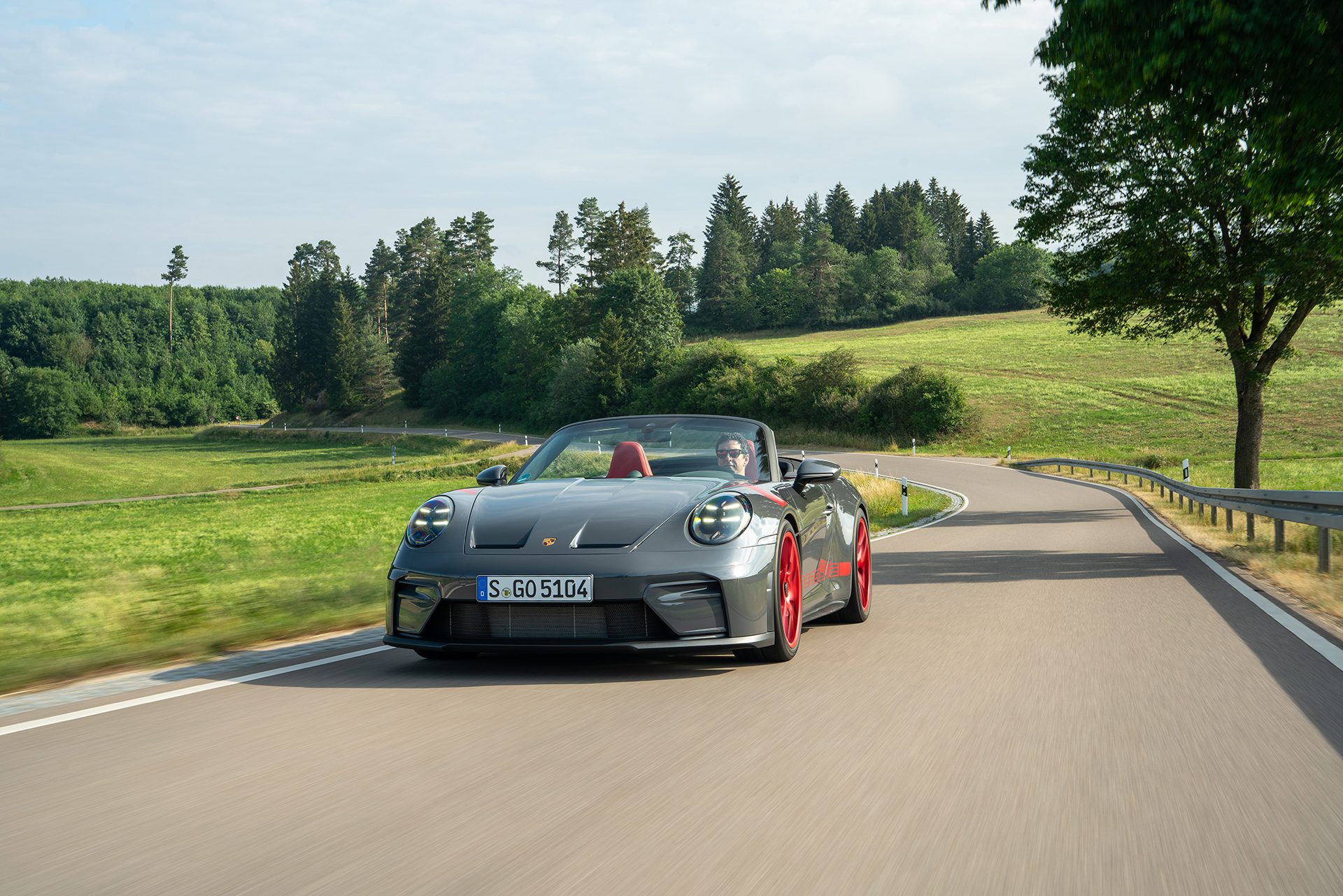

Can Porsche’s Convertible GT3 Really Live Up to the Name?
Weissach’s latest addition to its track-bred lineage takes the heretical step of going soft up top. Can it still be a real GT3? Gez Medinger heads to Stuttgart to find out.
For over a quarter of a century, the periodic release of a new Porsche 911 GT3 has not been unlike that of a Fast & Furious sequel. The one sure thing: the new one will be just like the old one, but more. More downforce, more grip, more thrills, more dynamic explosive action.
So, imagine if Universal did the unthinkable, and released a sequel without our favourite follically challenged star, Vin Diesel? How then could it possibly do the franchise justice?
Because the same question now befalls Porsche’s latest GT3, the roof-less S/C. Shorn of its whole raison de naissance – race-derived, track-centric focus – how could it possibly live up to the name?
Thus, this trip to Stuttgart poses three crucial questions to answer. Is a GT3 cabriolet an oxymoron? Does the S/C know what it is (as all the best cars do)? And I must keep an open mind on the third, the unthinkable: much like the idea of a Fast & Furious sequel without Vin Diesel – whisper it… might it actually be better?
Can a Convertible Really Be a GT3? Porsche's GT Boss Responds
To the first question, I put it to Andreas Preuninger, the director of Porsche’s GT division, that some people say the S/C can’t possibly be a GT3 without a roof. He hesitates not one moment in his response, dismissing the suggestion outright.
Still I’ll come right out and state the baggage I bring to this particular discussion: I don’t like cabriolet versions of originally roofed sports cars. The process itself brings a hatful of all the worst kind of compromises. The extra weight and wobble making the car less good at its sporting brief, while the impact on packaging and refinement annoy you when sporting japes are the last thing on your mind. And an underrated but important consideration for a car that really ought to be generating lust – cabs always look worse with the roof up than the original coupe, which let’s be honest, in the UK will be 99 per cent of the time you’re approaching or departing the beast.

Gez Medinger
Journalist
Table of contents
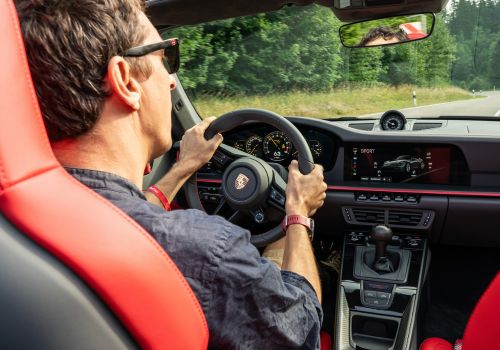
How Porsche Engineered the Lightweight GT3 S/C
Engine and performance
But before we get to Preuninger’s more considered response to these stock grievances, let’s quickly speed through what the GT3 S/C is. In the simplest of terms, it is a Touring without a roof. So, the same 3996cc naturally aspirated flat-six engine and six speed manual gearbox (splendidly, no PDK option is available on the S/C) featuring identical suspension hardware and setup.
The bald numbers: 503bhp, 1497kg, 0-62mph in 3.9 seconds and a top speed of 194mph. Figures exactly the same as the 1461kg Touring in manual guise, bar that smidge more weight. Are you surprised that a cabriolet with a fully automatic roof (taking just 12 seconds up or down) can be within 36kg to its famously svelte sibling? I was. This no-doubt devastatingly floppy spin-off must have been the marketing department’s terrible idea, I mused as I digested the press release.
But upon interrogation of the S/C’s engineers, it turns out this assumption was spectacularly wide of the mark. The genesis of the S/C came directly from the GT product team, but the project would only go ahead based on two conditions from Preuninger himself: it had to weigh less than a tonne and a half brimmed with fuel and fluids, and remain absolutely true to GT standards of dynamics.
Weight-saving measures
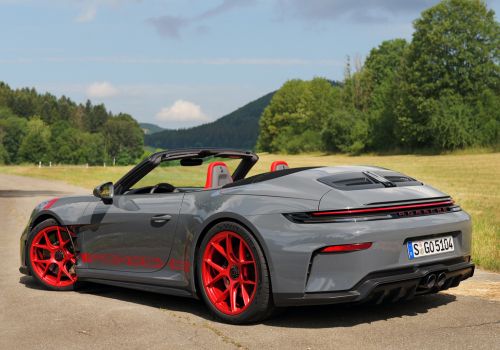
So to the first challenge of weight, the parts catalogue from the revered S/T was plundered – its carbon doors, front wings, frunk lid, rear anti roll bar and shear plate were all filched, along with its forged magnesium wheels. PCCB (carbon ceramic brakes) become standard, whilst magnesium forms large sections of the S/C’s roof. These measures offset half of the weight gained from the cabriolet body shell (40kg) and roof mechanism (36kg).
Chassis and suspension
On the challenge of dynamics, double wishbones at the front were non-negotiable, so the roof-less Carrera 4 body-in-white was modified to accept the mounting points for the GT3 hardware. Torsional stiffness of the S/C is rated at 27,000 Nm/degree, a 25 per cent improvement over the 991 GT3 Speedster and comparable to the fixed-roof, aluminium chassis Lotus Emira.
After the press briefing, I made sure to press Preuninger with my nerdiest questions. He was more than forthcoming. The Carrera 4 cabriolet shell was used (as opposed to that of the Carrera 2) because they wanted the central space used by the front differential for extra tank capacity. It’s more than stiff enough for the job, and he doesn’t believe it’s possible to discern chassis flex on the public road.
The S/T’s single-mass flywheel remained on the shelf as the S/C had a different (more ‘usable’) brief. But don’t rule out a future 992 Speedster which takes on the S/T’s rev happy (and clattery) nature.
The S/C generates 16kg of downforce at speed because it retains all of the underbody strakes of the GT3, as well as a gurney flap on the tail to aid stability. It’s not a number Porsche publicise (being well short of its fixed-roof and be-winged siblings), but Preuninger argues it’s a huge difference over the 150-200kg of lift that comparable drop-tops can make at autobahn speeds.
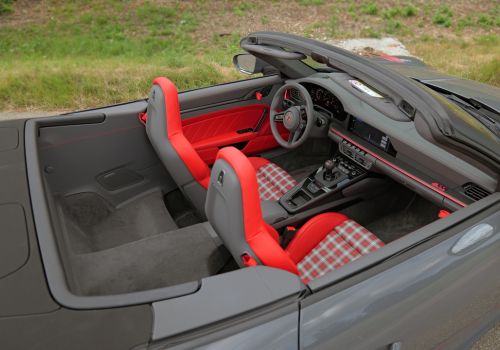
The carbon bucket seats are an essential specification choice (over the 18-way electric sports seats) as the damping of the car was honed in harmony with the damping of the seat, and road feel through the seat of your pants is a key part of the GT3 experience.
And perhaps the most surprising of the admissions – the S/C is the most drift happy of all GT3 models, a function of its slightly adjusted front to rear weight balance.
Most importantly though, what does Preuninger think the GT badge actually stands for, if not homologation-adjacent racetrack focus? ‘The most connected, immersive driving experience for either road or track’. Enlightening.
It makes sense that removing the roof of your manual, lightweight, naturally-aspirated sports car will connect you more viscerally to the process of progress – so long as it doesn’t also come bearing the compromises usually associated with the breed. Which, apparently, the S/C does not. Perhaps this controversial roof-chopping move is in line with the GT3 ethos after all.
Indeed after an hour spent with Preuninger and the GT product team, I became a giddy convert, my previous baggage having been dispatched to the wheelie bin outside. Extensive interrogation had revealed that the S/C, in philosophy, engineering and execution was a distillation of everything that I loved in a sports car. There was simply no way that it wasn’t going to press all of my buttons at once. I couldn’t wait to get behind the wheel.
Table of contents
First Drive: Porsche 911 GT3 S/C Review
Fast forward to the next morning. I gleefully hop in to our Slate Grey Neo Street Style equipped example as we leave early to capture some photos. The cabin is wonderful, as you’d expect. All the physical controls you want, and a driving position you can set up to be just so, whatever your genetic ratio of arm to leg. It doesn’t normally take long to get used to any 911, so I’m expecting to feel right at home immediately.
But that doesn’t happen. As I try to follow the camera car I can’t change gear, brake, or accelerate with any modicum of grace and I also appear to be unable to drive in a straight line. To add further ignominy, I stall the car whilst attempting to pull out of a lay-by behind the camera vehicle. I force a smile for the photos, despite feeling like a clueless 17 year-old kangarooing down the road for the first time.
On launches like this, it’s typical to share a car with a fellow journalist for the day. I return to the hotel and he hops in, whilst I quietly hope that I can be somewhat more competent with an experienced (and very possibly judgmental) eye beside me. On the plus side, the roads an hour south of Stuttgart quickly prove to be fantastic. Sweeping, open and smooth A-roads through spectacular countryside with very little traffic.
Not long into our three hour morning route, I pull out for an overtake. Despite having 9000rpm to play with, I need to find third mid-manoeuvre. As one hand comes off the wheel to do so, the S/C crosses a slight camber in the off-side lane. My left hand moves a few millimetres without the stabilising influence of the other, and as a result the car follows the camber, deviating in an alarming manner. Despite the almost quaint 0-60 mph time, the GT3 S/C remains a very fast car – so the speeds you overtake at are not trivial, and neither are such deviations. Overtake complete, I exhale and apologise to my passenger. That was not as comfortable as I would have liked. What the hell is going on here? Have I forgotten how to drive?
And then I have an epiphany. My LHD muscle memory has just spent a thousand miles being brutalised in a 45 year old classic, where everything requires Herculean inputs of both amplitude and force. I’ve got used to shoving, sawing and hauling all of clutch, brakes, throttle, steering and gears. And this S/C, honed to within an inch of its life, doesn’t want that. It doesn’t want it at all.
Learning to Drive the GT3 S/C Properly
The problem seems to be amplified as we navigate this now tight and twisty section of Schwäbische Alb, slowed by pesky locals and their bucolic pace of life. Ambling through beautiful countryside makes me realise that I’ve also been duped by the absence of roof in the S/C. Because unlike so many others of its open-topped breed, this is not a car that is happy to mooch.
It is a sinewy Weimaraner, bursting with youthful vigour, only just out of puppyhood. And as you proceed at any kind of moderate pace, it quivers on its haunches, every muscle taut and ready to explode, watching the stick in your hand with absolute solitary focus. Never settled, just waiting for its moment to come, which it surely must.
Every single control the S/C provides is designed for maximum communication in both directions and as a result the inputs it demands you make are tiny. And at anything under seven or eight tenths it struggles to find a rhythm, there always being a tension between the car, the road and you. The engine, damping and steering all yet to find their harmonic fluency.
It takes a whole day for me to finally tune into the 911, by which point I and my fellow journalist (unnamed to preserve his professional dignity) have both managed to stall it twice. We return to the hotel, and I borrow another car to see if the slight hesitancy at part throttle and mid-range revs is a common feature (it is, but needless to say wide-open throttle is sensational everywhere).
I have 15 minutes before the shuttle bus to the airport leaves. It’s just me in the car now, and my synapses have finally rewired themselves to the S/C’s language. Leaving the village at 30km/h, the car is yet again on its haunches, quivering. The derestricted sign then beckons – wide and deserted roads beyond.
On the Open Road: Where the Porsche 911 GT3 S/C Comes Alive
I pull my arm back, feint one way, and then throw the stick as hard as I can in the other.
Table of contents
Suddenly everything makes perfect sense, as the Porsche erupts toward the horizon – because this is the drop-top GT3’s happy place. And, for what it’s worth, mine too.
Everything that the GT3 Touring does to a road like this, so does the S/C. Only in this environment – a snaking, empty A-road carving its way through the rolling hills ahead, the S/C gives you more. More of that glorious flat-six wailing just behind your head. More sensory intoxication as you cleave through the juniper-studded meadows and hungrily biting horse flies. And, as you nail a perfect downshift (ego-insulting auto-blip switched off long ago), the nose pitched into a sweeper with the brakes bleeding off, all 1497kg in perfect balance, you think – can it get much better than this?
And, having taken a Touring out for a back-to-back blast at lunchtime, just to be sure, the answer is no. It can’t. When you finally get a chance to throw that stick, the highs are higher in the S/C. It is that much more visceral, that much more overwhelming in the intensity of the experience it can deliver. On the grounds of Preuninger’s assertion that a GT car should be the ultimate in driver connection and immersion, whether on road or track, it’s hard to argue that for the former the S/C is as good as it gets.
Yet there are still some contradictions remaining. If you want a convertible to cruise in, this isn’t the one. For the kind of speeds you would normally expect a drop-top to work at, this one does not. It demands more. Will being perpetually quivering on its haunches grow tiring on lumpy, bumpy, potholed B-roads? And just how often will you get to throw the stick on the UK’s congested highways? Be under no illusions, when you’re caught in traffic the S/C is like a puppy that’s been kept inside all day. It will start chewing the furniture.
Verdict: Is the Porsche 911 GT3 S/C Worth Buying?
So, to those questions posed at the start. Does removing the roof remove the essence of GT3? Categorically not. Does the S/C know what it is? Yes, but it took me a day to find out. It’s not a second car, it’s a third or fourth. It is a car for those opportunities when you want the highest highs, and nothing else will do.
Most importantly, like a franchise without its star, could it ever be superior to those that came before? I am man enough to admit that I shed a tear at the end of Fast 7, so beautifully judged was the way the creative team honoured the late Paul Walker (himself a true car enthusiast to the last). Universal managed it, and in the S/C, Porsche have too. In the specific conditions for which their latest is intended – glorious, open roads driven at eight tenths or more – the answer is unequivocal.
And this is where I leave the metaphor behind and put my own judgement on the line. Porsche is going to sell bucketloads of S/Cs. And it will deserve to. The world is starved of cars that demand this much of you, cars that require you to be better, because they won’t do the driving for you. Cars that reward you not just in spades, but in frunkloads when you get it right. When was the last time you stalled a car? What’s better – a sports car that calls you out for not meeting its high standards, or a supercomputer silently bailing you out when you fall short?
Because this is what we signed up for, the moment we first experienced the joy of nailing a hill start or chirping the tyres into second. The pleasure of learning, the deep satisfaction of getting better at a difficult skill. You only get back what you put in, and mein Gott is the S/C generous with its reward when you throw that stick just so.
2026 Porsche 911 GT3 S/C Specs, Performance and Price
Specifications |
Detail |
| Engine | 3996cc flat-six naturally aspirated |
| Transmission | 6-speed manual, RWD |
| Power | 503bhp |
| Torque | 332lb ft |
| Weight | 1497kg (wet) |
| Power-to-weight | 336bhp/tonne |
| Weight | ≈ 1,755 kg (DIN) |
| 0-62mph | 3.9sec |
| Top speed | 194mph |
| Price |
£200,500 |
| Ti Rating | 9/10 |